
Your Google listing sits at 4.2 stars. You want 4.7. The question every owner asks is the same: exactly how many reviews does that take? There's no magic to it. It's arithmetic. And once you understand the math, you stop guessing.
The math behind your stars
Your Google rating is a simple average. Add up every rating you've received, divide by the number of reviews. That's it.
Here's a concrete example that answers how many Google reviews to raise your rating. Say you have 50 reviews and a 4.2 average. That's 210 total points (50 × 4.2). To reach 4.7, the new average has to climb.
If your next reviews are all 5 stars, each one pulls the average up, but with less force as your volume grows. Starting from 50 reviews at an exact 4.2, you need 84 new 5-star reviews to reach 4.7. At 80, the average is 4.692, which does not cross 4.7. A 4.2 displayed by Google may already be rounded, so the true total may not be 210. That 84 applies only to this example.
Why your starting point changes everything
The number of reviews you already have carries real weight. A business with 20 reviews moves fast. A business with 300 reviews moves slowly.
It's mathematical: the wider your base, the less any single new review moves the needle. The good news is that if you're starting small, a handful of good reviews is enough to watch the average jump.
The other factor is negative reviews. A single 1-star can wipe out the effect of several 5-stars. That's why you collect continuously, not just in the wake of an unhappy customer.
The real key: consistency
The classic trap is asking for reviews in one big push, then nothing for six months. Google rewards freshness. A listing that earns reviews every week builds more trust than one that's been frozen since last year.
To pull that off, you have to make the ask effortless. A customer is most ready to leave a review in the moment, right at the counter, not three days later by email.
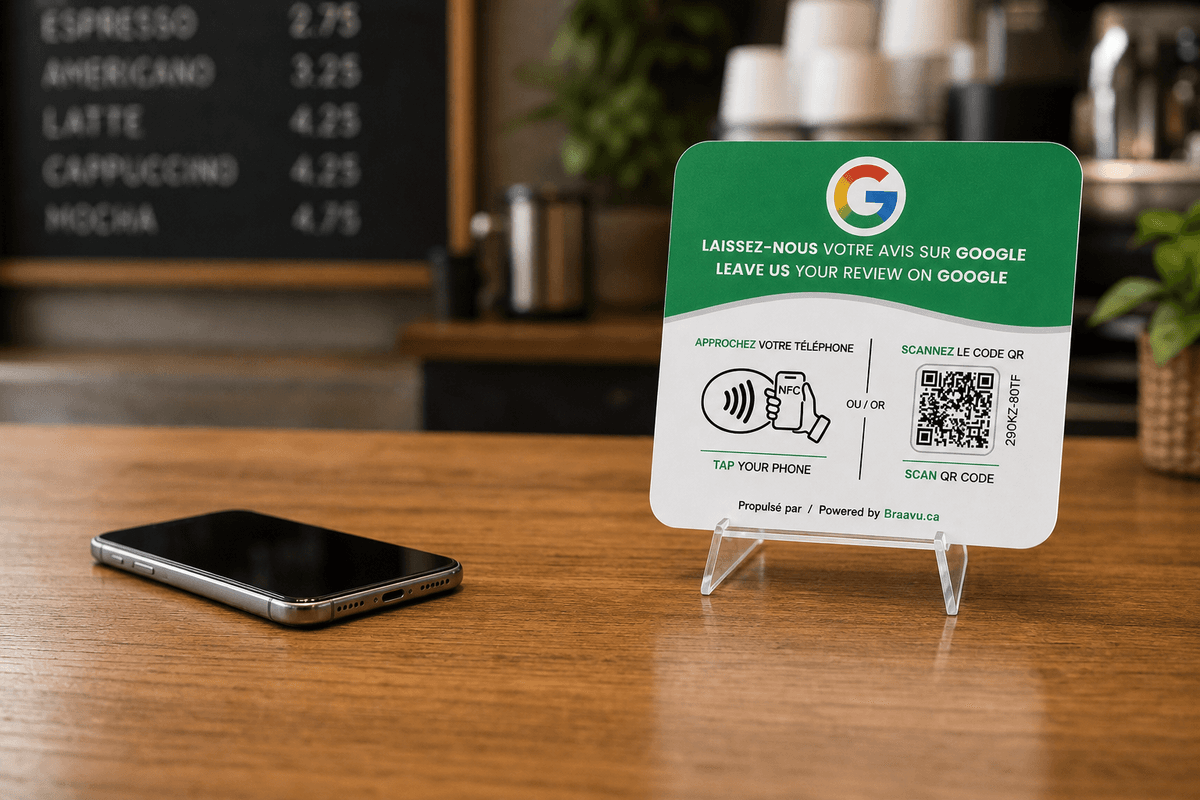
That's where a review plate on the counter earns its keep. The customer taps their phone or scans the code, and your Google review page opens with a single tap. No app, no searching, no friction. You capture the moment while the experience is fresh, before they walk out the door.
To lift your stars, the Google review plate opens straight to your review page. It's also known as a review plate, review card, review stand, or review sign.
A realistic target
Going from 4.2 to 4.7 won't happen over a weekend. But with a simple ask offered to every customer, the volume adds up. A few reviews a week, and the average climbs on its own.
The mistake is waiting for the "right moment." The right moment is the end of every visit.
Braavu sells one plate, NFC and QR. It opens the page to write a Google review for the listing you chose. Change that listing for a location, and every active plate at that location follows, without a reprint.
Bottom line: Your stars climb through arithmetic, not luck. Collect honest reviews consistently by making the ask effortless at the counter, and the average will follow.